Death
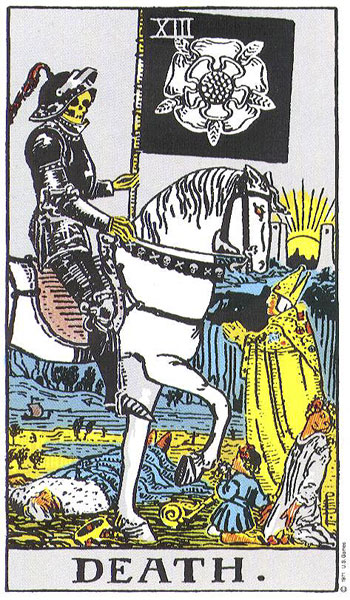
“The skeleton rides past kings and children alike while the sun rises between two towers: something is over, and the morning after is already in the picture.”
Upright meaning
Death is the deck's most honest card and its least literal: it announces an ending that clears the ground, a stage of life, a role, a relationship's old form, an identity outgrown. Resistance prolongs the discomfort; acceptance shortens it. The card's promise sits in its own image: the sun rising behind the rider. Endings of this kind are not interruptions of the story but the mechanism by which it continues.
Reversed meaning
Inverted, the ending is being held hostage: a closed cycle artificially ventilated, change postponed until it arrives without your consent. The fear is understandable and the cost compounds daily. What you refuse to release is already releasing you.
In love
The end of a dynamic, sometimes of a relationship, more often of its old version. Bonds that accept the moult come out of this card sturdier; the ones that cannot were already over.
In work and money
Closures: projects, roles, eras. Mourn briefly and formally, then redirect the freed energy. The space an ending opens is the actual asset.
The card's advice
Bury what is finished with respect, and turn around: the exit was an entrance.
Symbolism of the card
A skeleton in black armour rides a white horse beneath a black banner marked with a white rose, symbol of purification. A king lies fallen, a child offers flowers, and the sun rises between two towers in the distance. Death takes everyone equally, and what it ends clears the ground for what follows.
Frequently asked questions
Does the Death card mean someone will die?
Almost never. It signals the end of a stage, a cycle or an identity so that something new can begin.
Why is Death often a hopeful card?
Because endings are the condition for renewal. The rising sun in the image points to what comes after.