
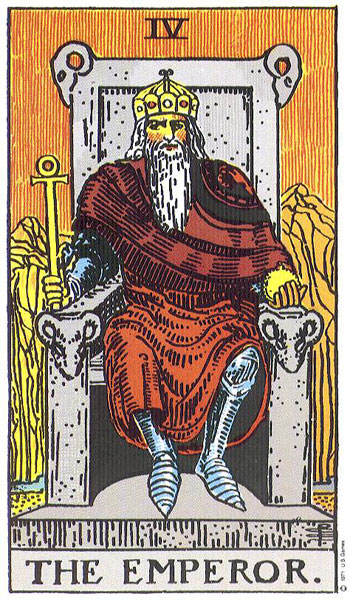
The Emperor
“A throne of stone above the orchard: nothing the Empress grows survives without borders to protect it.”
Upright meaning
The Emperor brings order where there was improvisation: rules, schedules, budgets, boundaries said out loud. He represents legitimate authority, yours or someone else's, and the security that structure provides. The card favours formalising, signing, leading and deciding. Tenderness is not his language; protection is. Build the frame and what matters can grow safely inside it.
Reversed meaning
Reversed, structure turns to cage: micromanagement, authoritarianism, rules outliving their purpose. It can equally signal the opposite failure, a situation suffering from nobody taking charge. Locate where control is excessive and where it is simply absent.
In love
Stability, commitment and protection, possibly a partner or dynamic where order dominates. Healthy if boundaries are agreed; ask whether structure serves the bond or replaces its warmth.
In work and money
Take command or negotiate with whoever holds it. Excellent for processes, contracts and long-term planning. Authority is earned here by consistency, not volume.
The card's advice
Decide, write it down, and hold the line you drew.
Symbolism of the card
The Emperor sits on a stone throne carved with rams' heads, symbols of Aries and of initiating fire. His armour beneath the robe and the orb in his hand show authority built on discipline. Behind him rise barren mountains, a reminder that order is made, not given: structure is what he builds against the wilderness.
Frequently asked questions
What does The Emperor represent?
Structure, authority, stability and the ability to protect and organise. He can be a person in power or your own capacity for discipline.
What is the shadow of The Emperor?
Rigidity and control. Reversed, he warns of domination, stubbornness or a lack of firm boundaries.